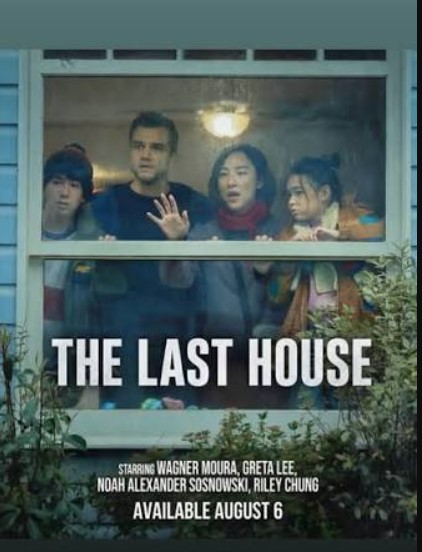
The Last House (2026) Netflix Review
Movie Review: The Last House (2026)
It wasn’t too long ago when Netflix released a German sci-fi about people being suddenly trapped in their apartment by a brick wall that won’t allow them to leave. Well, now we have another Netflix sci-fi with a very similar premise. Again, there are people finding themselves suddenly trapped in their home, and something on the outside is preventing them from escaping. Is The Last House simply a rehash of Brick from 2025? Or does this newest film do something creative?
A family of four is suddenly sealed inside their house with no way out and must work together to survive against both their dwindling resources and the mysterious looming threat that is keeping them trapped.
The Cast & The Family Drama
The cast, as I’m sure you can imagine, is pretty sparse. While we do briefly see a few other actors, the majority of the screen time is dedicated to Greta Lee, Wagner Moura, Riley Chung, and Noah Alexander Sosnowski. They’re a somewhat tight-knit family, but their patience and relationships are tested the longer the imprisonment goes on.
For so much of this film, it’s a family drama. We get tiny, vague glimpses of something that could point to what’s going on, but the film exercises patience before really showing us anything discernible or concrete. And for the drama, it’s effective. We spend so much time with the family that it’s difficult not to become endeared to them. Sometimes we don’t like their actions or behaviors, but for most of the first two-thirds of the story, they’re all rational, nice, and kind as well as stressed and sometimes scared giving them a mostly relatable presence in their demeanors.
Pacing & The “COVID-Era” Feel
The film is just short of two hours, and the time span the story covers effectively progresses us through days and months. It strikes a balance that allows us to get a good grasp on their mental outlook while also not forcing us to slog through all the minutiae of day-to day survival, especially as time moves forward.
In the beginning, it is important to show how the four relate, how they plan, and how they spend their time. But to avoid repetitive visuals, the storytelling then transitions to showing only the more stressful portions of their existence, allowing us to feel their declining morale and the growing hopelessness that’s just inevitable. During these times, the acting is wonderful. There is this believable tenor to the family’s interactions. They’re mostly cheery and uplifting to each other, but not without some snappiness that comes from just being trapped under the same roof with zero way to get away from each other.
In this way, the film does kind of feel like a COVID-era production. Everybody is in isolation and beginning to struggle with their mental health, while relationships also get tested in a whole bunch of new ways. Thankfully though, this doesn’t trudge down those familiar paths, instead leaning more heavily on the survival aspect that comes about naturally when imprisoned within a home, just as all the other residents and neighbors are. There’s no DoorDash or Uber Eats if you didn’t go to the grocery store before the strangeness ensued. You are just SOL once your supplies run out. From that angle, the story does maintain an aura of originality and freshness despite sharing similarities with the German sci-fi Brick that I mentioned at the start, or even with most of the productions that came out from 2020 to about 2022.
A Rushed and Clumsy Finale
But for as engaging and heartfelt as the first two acts are, the film then inexplicably rushes the final act, creating an almost laughable and forced ending that dismantles so much of what had been established before.
The movie employs a voiceover at the start, almost like someone recollecting the past from their present perspective. This is fine, although we don’t know exactly who is speaking at the time. It works to prevent any other voiceovers from feeling strange and wildly out of place. Also, these are used sparingly maybe three times at most. The lack of use is nice so that it doesn’t become too much of a narrative crutch with which to deliver exposition. But while the dialogue was intriguing and mysterious at the beginning, it feels more cheesy and trite at the end.
That’s probably because the resolution the story arrives at is so far-fetched and implausible, even for a sci-fi film where we already need to suspend some disbelief. And don’t hear me say that the reveal and explanation were terrible there are some excellent visuals that reinforce all of the wonkiness and fear that’s being built but it’s how the actual resolution comes about. I’m pretty sure there’s a morality play working on some level as a cautionary tale, banking on the final message that the story leaves us with. But the execution is so clumsily forced that any effectiveness is lost, leaving us with cringe more than anything else.
The end is so neatly and cleanly resolved, just wrapping it up with a tidy bow and going to the credits, hoping that the audience isn’t going to notice the amateurish simplicity and convenience of the conclusion. Even before that, while there is an exciting action sequence full of energy, urgency, and tension, the script goes full Kevin McCallister with dialogue that is super close to, “This is my house. I have to defend it.” I laughed when this sentiment was spoken. It took a movie that had been patiently but steadily building direness and transformed it into a punchline of an ending.
Final Verdict
It’s such a shame, because up until the final 15 or 20-ish minutes, I was vibing right along. Now, this didn’t completely ruin the film for me, but it does create this huge hurdle to me ever wanting to revisit it.
Greta Lee and Wagner Moura create emotionally wrenching performances, showcasing relatable mindsets and behaviors of parents who are not only struggling to survive but also to prevent their young kids from fully knowing the bleakness of their reality. The CGI and effects look good, with some visual creations that are uniquely blended to craft something horrendous and freaky. Even the concept for the story and the execution of the passage of time work to reinforce dread and hopelessness, avoiding repetitive scenes in favor of the efficient delivery of varied experiences.
Unfortunately, the story falters at the finish, rushing actions and employing absurd plot conveniences to end the movie. It’s almost as if the writing had everything completed except for the conclusion, and then slapped something together at the last minute just so that the production could wrap up. Up until the finale, this was a great character study on the survival of relationships within stressful and desperate circumstances, and then it became stupid.
I give The Last House two and a half out of five couches. I wanted to love this in its entirety, but that ending.
Outro
Okay, are there any survivor-type movies that you absolutely love? I mean, for me, I adore The Martian. And then, despite its bleakness, The Grey is also a good one. Let me know what you love, though, in the comments below.