Undertone (2026) Movie Review
What Makes This Release Stand Out? A Review of Undertone
Do you enjoy creepy audio? This could be stories, audiobooks, soundtracks, or even podcasts. Well, if you decide to watch *Undertone*, you may think twice before loading up a new spooky track. The host of a popular paranormal podcast becomes haunted by terrifying recordings mysteriously sent her way.
So, the whole marketing around this film is centered on the idea that it is the scariest movie you’ll ever hear. If they’re going to accomplish that, the sound design has to be perfectly on point, which puts a ton of pressure on the sound team to create an atmosphere that invites us in and introduces a creep factor that is going to make us forget our shorts.
A Podcaster and an Unreliable Narrator
The story follows a podcaster and her co-host, Evy and Justin, respectively, and they do a weekly show called *The Undertone*, where they examine some spooky ideas. When Justin gets a cryptic email with ten audio files, he and Evy slowly dive into them as they record.
All the while, Evy is caring for her mom, who appears to be slowly dying from some unknown condition. That’s not the point of the film. The reason that she’s sick isn’t important; it’s the time, the toll, and the effort that Evy exerts in her caregiving, which then works to erode Evy’s stamina and potentially even her sanity.
This is a stripped-down film with a minimal cast and even less shown on screen. Most of the actors who are in this only lend their voices, making the performances all the more powerful when they can elicit goosebumps from their words and their inflections. Evy and her mom are the only ones we really see throughout the whole 93 minutes, which could sound a bit dull from a visual perspective, but this is anything but lazily presented or even uninteresting.
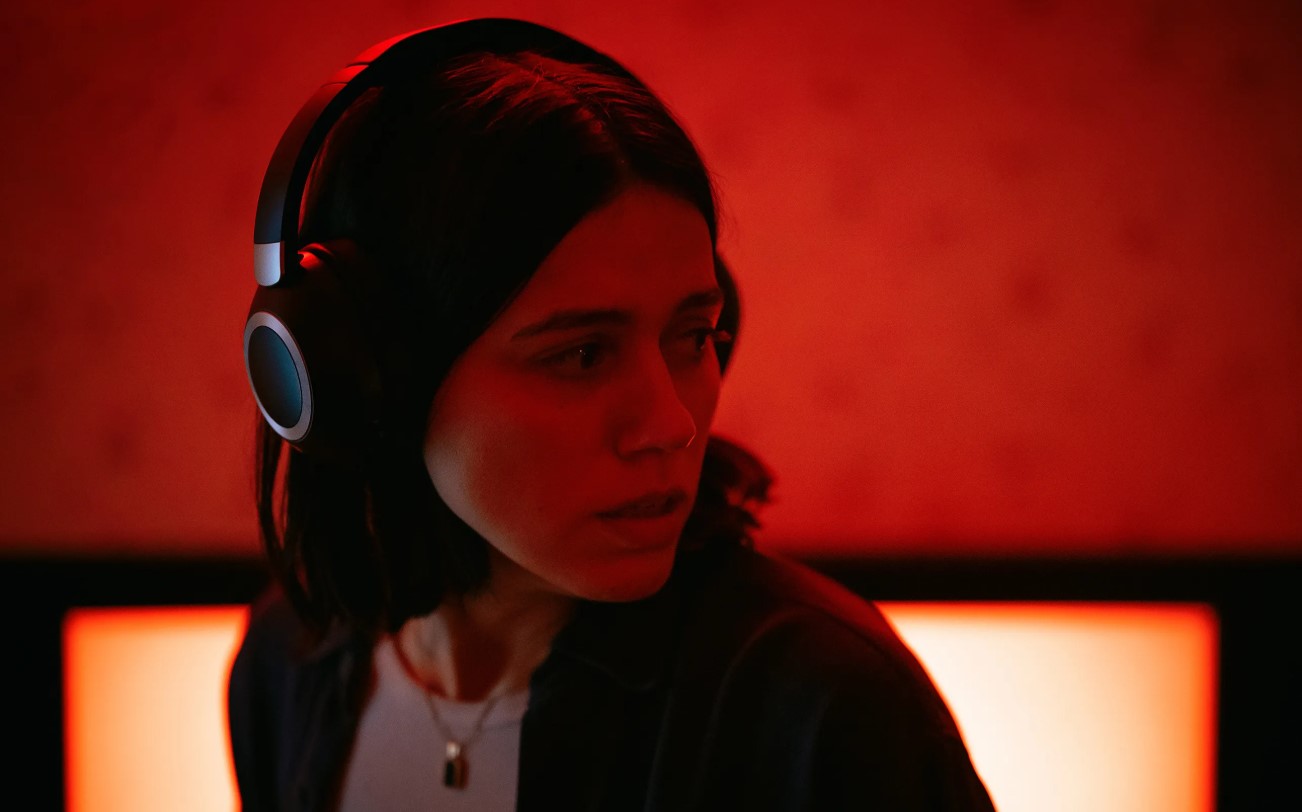
The performance from Nina Kiri, who plays Evy, is superb. She exudes a ton of compassion that’s mixed with exasperation and burnout. It’s impressive and enveloping when Evy goes into some sort of zone-out face. She’s not necessarily in a trance, but she certainly drifted off, which then makes her a bit of an unreliable narrator, but also one who gains a lot of sympathy just from her defeated expressions.
The Art of Audio Horror
Most importantly for this film, her voice is crisp and inviting, but not cold or DJ-sounding, like she’s putting on a radio voice for the podcast and sounds completely different all of the time. If you’ve ever met a DJ or even watched them in person while working and then compared them to outside of the radio booth, they typically are more toned down and create less of an edge to their voice. Point being, though, although we hear both Evy and Justin talk about getting into character for their podcast, there’s not a large, noticeable shift in their stylings.
As a skeptic, Evy is supposed to be the voice of reason—the one that Justin has to convince that something feels legit or is real. Despite her being a bit of an unreliable narrator just thanks to some of the daze that she starts to fall into, she’s also able to maintain the needed skepticism that creates just the right amount of doubt to make everything seem a little bit more plausible.
The whole audio presentation of this film is entrancing. When Evy puts on her headphones, we hear all of the ambient sound in the room just go immediately silent, creating this very lonely and isolated environment until she dials up Justin to record or she happens to listen to some audio. When the exquisite sound design is then coupled with the patient filming style, the unsettling nature of the story takes hold, and it just works to get under our skin.
Visual Restraint and Taut Pacing
I love it when a film will have the camera locked down on a subject, not panning or zooming, just simply remaining focused on one area as the character or item stays in a stationary spot. When this technique is combined with a horror story and there are all sorts of shadowy areas inside the frame, I almost pop my eyes out of their sockets trying to strain to see any sort of clue or movement. Most of the time, it’s just tricks in my eyes that create something moving in the dark. But that doesn’t mean that there’s *never* nothing hiding in the shadows. The patience it takes to not put jump scares or creepy imagery in the background is huge, making it all the more effective and horrifying when there actually is something looming in the dark.
The pacing for this is taut and efficient. While there’s a massive amount of restraint in the speediness, it’s not boring, nor does the story drag. We’re on this inclining ramp that starts off rather tame and then begins to exponentially increase in dread and fear so that it appears as though we’re rocketing through the story. But in reality, it’s just the mounting stress that’s creating that illusion of speed. When things start to go off the rails, they get harried and terrorizing, mixing discombobulating audio with quick and terrifying visuals that assault us in alternating and overlapping sequences so that at the climax, it’s just this sensory overload that doesn’t create confusion, but instead builds a great big *nope*.
A Devastating Climax
There’s one call that the hosts take towards the end of the story, and it is all kinds of terrible. We never see a thing, but thanks to descriptive storytelling earlier in the narrative, we know exactly what’s taking place on the other end of the line, and it is abominable. While there are many moments throughout the film that made me squirm a bit, this particular sequence shattered me, and it just made me feel the revulsion, rage, and horror that the audio is meant to evoke.
There are several aesthetics within the presentation that remind me of two effectively scary films. One is the Taiwanese supernatural folk horror, *Incantation*. If you’ve not seen that, you are in for a terrifying treat. The other is the COVID-era virtual supernatural horror, *Host*. That one’s a quick 60-minute film that works amazingly well just to bring about the chills. For *Undertone*, elements of those two movies are introduced in small ways, but they don’t feel like ripoffs or plagiarism, instead appearing more as influences to bring about a brand new story of fright.
For me, the biggest shortcoming of the entire film is the very end. As all hell breaks loose and the events go from gnarly to just bat-crap, we lose all of the visuals. I certainly appreciate and even understand that for a film centered around messed-up audio, it’s fitting that the story solely uses audio as its finale. But because the movie is also a visual medium, it came across as a bit of a copout for not having to show or visualize the very end. I think the audio is still not okay—in the best way possible—and it does work to force me to create my own interpretation of what the audio represents, but I still would have liked to have something other than a black screen to accompany the final minutes.
Final Verdict
As it stands, though, *Undertone* accomplishes its goal of creating a foreboding and threatening atmosphere, using spectacular audio and sound design to build a world mainly out of sounds. Both the physical and voice acting of Nina Kiri and the voice work of all the other actors draw us in with welcoming or intriguing tones, only to then scare us thanks to a mythos and storyline that are pure nightmare fuel.
I don’t know if this is the scariest movie I’ve ever heard, but it is superbly executed and creates a lasting dread long after the credits are done. The audio is very explicit in the imagery that it conjures.
Rating: I give *Undertone 4.5 out of 5 couches.
Despite preferring a different way to conclude the movie, on the whole, this was an exciting and distressing horror. I hope it freaks you out just as much as it did me!
Okay, are there any supernatural horrors that have stuck with you long after you watched? Let me know what they were in the comments below!