Oppenheimer (2023) Movie Review
Movie Review: Oppenheimer
Christopher Nolan’s long-awaited atomic epic Oppenheimer has finally arrived. I saw it in stunning 70mm IMAX and sat through all three hours and nine seconds of this drama. With one of the most celebrated directors at the helm and a stacked cast to match, the question on everyone’s mind is simple — is this Nolan’s magnum opus?
A Stacked Cast and Stunning Visuals
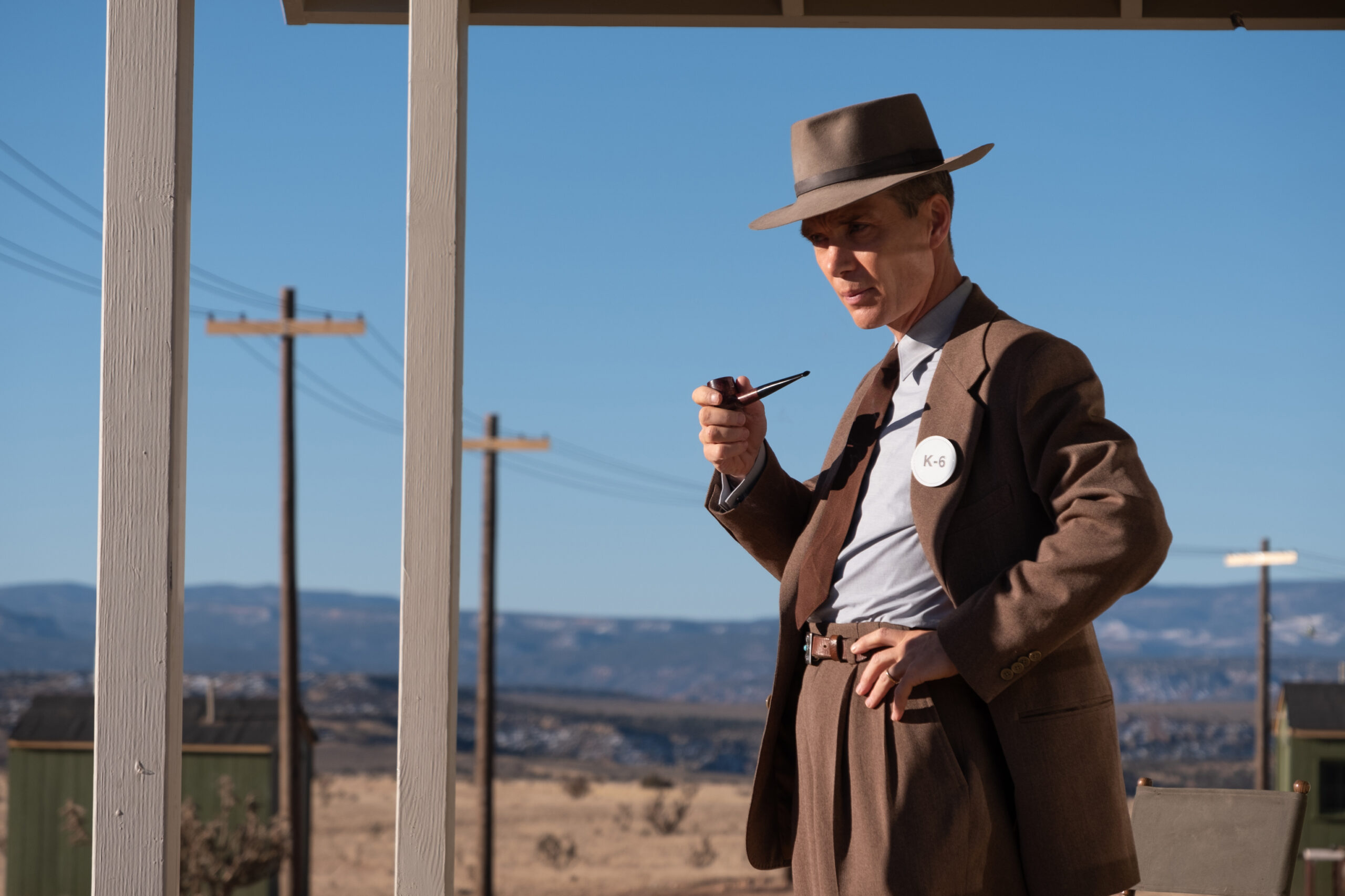
Oppenheimer tells the story of American theoretical physicist J. Robert Oppenheimer and his role in the development of the atomic bomb. While the film stars Cillian Murphy, Emily Blunt, Robert Downey Jr., and Matt Damon, there are so many other actors that appear in this that it would really take just way too long and become very boring for me to list them all. Suffice to say, though, that in just about every frame I was noticing a new but familiar face. I love how stacked the cast is, and even if a character had a very minor role, it was fun to see them on such a huge project.
As I said, I saw this in 70mm IMAX on a five-story screen. While the aspect ratio constantly changes throughout the film, when it goes full screen, the imagery is nothing short of stunning. Portions are in a widescreen format, and when we need to see expansive locations or maybe the grandeur and massiveness of an area, the picture goes full screen to just completely dominate our field of view. I am curious how this is going to look on a non-IMAX screen, or even on an IMAX that doesn’t have 70mm.
Even before we see an explosion, we’re shown images of particles and embers as they float chaotically but rhythmically across the screen. The colors are typically very vibrant, which then stand out all the more against the utterly black backdrop. Something that’s wonderfully visual is that when we’re watching certain aspects of the story, the presentation is in black and white, and these too are breathtaking. The depth of the blacks and the grays is somewhat mesmerizing, and it makes the scenes enveloping.
Brilliant Performances
Cillian Murphy is brilliant in this. While he’s not totally shown as a hero, he is displayed as a human being—flawed, insightful, and sometimes charismatic—making him human rather than lifting him up as infallible and perfect. He then becomes very relatable and sympathetic. Not all of his actions are noble or honorable, but there is a sense of honesty that’s portrayed as he knowingly struggles with his thoughts and actions. One thing that really stood out to me was his ability to express the moral dilemmas that he wrestled within his mind. The emotion that’s captured in his eyes just speaks volumes, and while there are portions when Murphy isn’t actually speaking, his eyes are shouting his thoughts loud and clear.
Matt Damon is another standout in this. He doesn’t have nearly the same amount of screen time as Murphy, but his presence is wonderful. There’s a charm that Damon has that just comes across in all of his acting, even if he’s not playing somebody that we are meant to be fully behind. He’s able to draw us in with his sincerity and the matter-of-fact attitude that he brings to his soldier character. It’s convincing, and it balances well against Murphy’s science-based background.
I was a little shocked at how much screen time and story prevalence **Robert Downey Jr.** had in this. While it’s hard to separate him totally from his Tony Stark character, he is wonderful to watch because of the hubris that his character displays. The pride and self-assuredness are both impressive and sickening, and RDJ captures it flawlessly. He’s a character that we love to hate if given the chance, and he’s also played with a smarmy angle, which then makes him even more of a robust and nuanced character.
Florence Pugh has a small but significant role, and I like the darkness of her character. She brings a level of complication to the story, and while that complication probably would still exist without her character, Pugh and Murphy have a good and dysfunctional chemistry together.
Finally, with Emily Blunt, she doesn’t have a ton of story time, but when she’s on screen, she absolutely sells the performance. There are very subtle characteristics she displays that give us huge insight into her character’s state of mind. I love how much passion she brings to her character as Oppenheimer’s wife; she’s explosive and intense and makes a great match for the quiet of Oppenheimer. Their dynamic works, even if it’s not always healthy.
Storytelling and The Score
Despite this being three hours and nine seconds—which I know is just a funny fact, but Nolan made a big deal of actually pointing that out—I was fully enthralled in the story. This takes us through a large portion of Oppenheimer’s life, and it’s told as sort of a mystery or even a courtroom drama, even though there isn’t any courtroom. The level of detail we get in his story is incredible, showing how things in his past haunt his present, especially where governmental clearance is concerned. Sometimes the narrative felt like it was packing in too much information, but as the story progressed and more context was provided, the scenes began to fall into place, rounding out the story angles which then created some really robust plot lines.
Something Nolan has always utilized well in his movies is the score to just elicit energy and emotion, and here it’s no different. The score is by Ludwig Göransson, and there is so much to love about it. Something that really stood out to me was the use of intermingled sounds with the score to create urgency and even dread. For example, as the bomb is being constructed and then loaded for testing, the music is swelling and building with all this intensity, and sprinkled throughout are sounds of a Geiger counter. It’s subtly reminding us that what we’re watching is radioactive and insanely dangerous.
There are also several times when the music crescendos to such a point that you almost want to cover your ears; it’s meant to be somewhat deafening as it matches the internal thoughts and fears of Oppenheimer. Masterfully, there are also sequences of silence, and that, too, can be deafening, as we just wait with anticipation for what’s coming, allowing that silence to almost suck the air out of the room—kind of like the initial explosion of the bomb before the shockwave travels out to decimate everything in its path.
Technical and Pacing Issues
Something that is of issue is the balance between musical score volume and dialogue. It’s not nearly as bad as it was in *Tenet*, because throughout most of this, the dialogue is very discernible and audible. But there are some key moments where we’re meant to hear the words being spoken because of just their story importance, and I found myself really struggling to hear what was being said over the volume of that score. I wish this wasn’t the case, because in these instances I was broken out of the story and then immediately aware of my surroundings. The illusion of the story disappeared, and I had to enter back into it.
At times, also, the camerawork was a little distracting as a shallower depth of field was utilized, causing some of the subjects to fall out of focus, especially on close-ups where it’s the most noticeable. This wasn’t an issue consistently throughout the film, but towards the end of the movie, it did become more prevalent.
Something I wasn’t expecting in this is that there are essentially two stories being told. They intertwine all throughout, but there is a distinct point that felt like the movie had reached its climax and was beginning to wrap up, only to then continue on for about an hour more. I was still completely invested in the narrative and I was loving the building intrigue and tension, but it was a noticeable shift in the storytelling that could make the movie seem even longer than it is for some. I think the convergence of the storytelling works very well and actually creates a somewhat suspenseful arc. I also enjoyed the events that then unfolded and how they influenced the rest of the story.
Final Verdict
This ends up being a thrilling drama with phenomenal acting, and it’s all topped off with a stunning and artistically shot explosion. The fear, dread, destruction, and even beauty—they’re all captured in this phenomenal column of fire.
Overall, Oppenheimer is a captivating story, wonderfully helmed by Christopher Nolan and expertly led by Cillian Murphy. The cinematography is magnificent, capturing the awesome power of a bomb while also showcasing the vulnerability and flaws of the humans that created it. While the camera’s focus on subjects is sometimes a little soft and the audio is a little out of balance at times, the musical score is emotionally moving and thrilling, guiding us through the excitement of discovery with the urgency of a looming countdown.
Rating: I give Oppenheimer 4.5 out of 5 couches.
So, are you excited for this film? Do you have a favorite Christopher Nolan movie? *Interstellar* is one of my all-time favorites, and I also really love *The Prestige*, but I’d love to know yours in the comments below!**